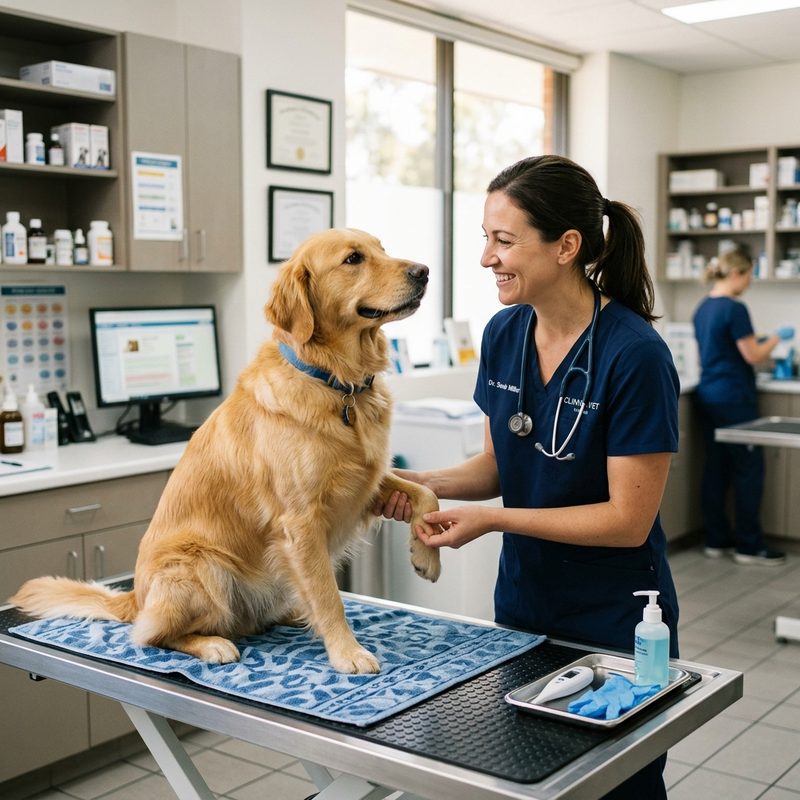
If you own a dog, you know the worst part of pet parenthood isn’t the slobbery kisses or the chewed-up slippers — it’s the vet bill. And in 2026, those bills are steeper than ever.
The Bureau of Labor Statistics Veterinary Services CPI rose 5.3% year-over-year as of February 2026, far outpacing general inflation. That means the same exam, vaccines, or surgery that cost you $500 a year ago could easily be $527 today — and the gap is widening.
Don’t guess — calculate. Use our free pet cost calculator — enter your dog’s breed, weight, age, and lifestyle for a tailored annual vet-cost estimate in 30 seconds. No signup needed.
How Much Does a Routine Vet Visit Cost?
$50–$100 for a standard office visit — and that’s before any tests, vaccines, or treatments. The exam fee alone is typically itemised separately from everything else, so don’t be surprised when the total at checkout is two or three times the exam price.
Most general-practice vets charge a flat examination fee. Speciality and emergency hospitals charge $150–$300 just to walk through the door. Many clinics now also add a medical waste disposal fee ($3–$8) and a pharmacy dispensing fee ($5–$12) to every visit.
Vet costs rose 5.3% year-over-year per the BLS Veterinary Services CPI (Feb 2026) — nearly double the headline inflation rate. The same visit you paid $200 for last year is now ~$211. Stack two visits a year and that’s $22 you didn’t budget for.
Vaccines — DHPP, Rabies, Bordetella
$80–$150 total for the core vaccine series.
Vaccines are typically priced per shot, and the cost varies based on whether you see a general practice vet ($20–$45 per vaccine) or a low-cost clinic ($10–$25 per vaccine). Here’s the breakdown:
- DHPP (Distemper, Hepatitis, Parainfluenza, Parvovirus): $25–$45 — given every 1–3 years after the puppy series
- Rabies: $20–$40 — required by law in most states, typically every 3 years
- Bordetella (“kennel cough”): $20–$40 — recommended for dogs that board, groom, or visit dog parks
- Leptospirosis: $25–$50 — regional, but increasingly recommended as the disease spreads
Bundle deals are common: many clinics offer a “puppy package” covering the full series for $100–$200.
Heartworm Test & Prevention
$50–$150/year total for testing and 12 months of prevention.
The heartworm test (antigen test, usually combined with a 3-in-1 or 4-in-1 heartworm-tick combo) runs $35–$60. Monthly prevention tablets or topicals range from $5–$15/month depending on your dog’s weight. Injectable ProHeart 6 or 12 (given at the vet) is $50–$120 per dose but covers 6 or 12 months at once — convenient, but requires a vet visit for administration.
Skipping heartworm prevention is a false economy: treating an established heartworm infection costs $1,000–$1,800 and is far riskier for your dog.
Dental Cleaning
$300–$800 for a routine cleaning under anaesthesia. $1,500+ if extractions are needed.
Dental cleaning is one of the most commonly recommended — and most commonly skipped — procedures. Unlike the “anaesthesia-free” cleanings some groomers offer (which are cosmetic only), a proper veterinary dental cleaning involves:
- General anaesthesia with monitoring
- Full-mouth radiographs (X-rays)
- Supra- and sub-gingival scaling
- Polishing and fluoride treatment
The cost varies dramatically by clinic and region. Rural vets may charge $300–$500; urban speciality dental vets charge $800–$1,500+. Extractions add $50–$150 per tooth, and a dog needing multiple extractions can easily hit $1,500–$2,500 total. Periodontal disease is the most common clinical condition in adult dogs — don’t skip this.
Spay & Neuter
$200–$800 depending on size, sex, and clinic type.
Low-cost spay/neuter clinics can perform the procedure for $50–$200, making them an excellent option if cost is a barrier. Private practice vets charge $300–$500 for a routine spay/neuter. Complicated cases — large-breed dogs, pregnant spays, cryptorchid (undescended testicle) neuters — can reach $600–$800 or more.
Pre-surgery bloodwork (recommended, especially for dogs over 5 years old) adds another $80–$150.
Emergency Veterinary Visit
$150–$300 just for the emergency exam fee.
Emergency and specialty hospitals charge at a premium — and that exam fee is just the entry ticket. Once inside, most dogs get:
- IV catheter and fluids: $80–$150
- Bloodwork (in-house lab): $150–$350
- Radiographs (X-rays): $150–$500
- Ultrasound: $400–$800
- Hospitalisation (per day): $300–$1,000
A “minor” emergency (laceration, mild toxicity, single seizure) typically runs $600–$1,500. A “major” emergency (GDV/bloat, hit-by-car, pancreatitis) starts at $3,000 and climbs fast.
Emergency Surgery — Foreign Body, GDV, ACL
$3,000–$10,000+ depending on the procedure and clinic.
These are the procedures that drain savings accounts, max out credit cards, and force heartbreaking decisions:
- Foreign body removal (gastrointestinal obstruction): $3,000–$6,000 — your dog ate a sock, a toy, or a corn cob
- GDV (Gastric Dilatation-Volvulus / bloat): $4,000–$10,000+ — life-threatening; requires emergency surgery to decompress and tack the stomach
- ACL / CCL repair (Tibial Plateau Leveling Osteotomy): $4,000–$8,000 per knee — common in large-breed dogs
- Fracture repair: $3,000–$8,000 — requires pins, plates, or external fixators
NAPHIA’s 2026 report shows pet insurance claims rose 22% year-over-year, driven almost entirely by the surge in veterinary costs. A single emergency surgery can equal 5–10 years of pet insurance premiums. If you don’t have insurance, you’re self-insuring against a $10,000+ event.
Get Odie Pet Insurance quote →
Senior Wellness Blood Panel
$100–$250 for a comprehensive senior profile.
Once a dog hits 7–8 years old (5–6 for giant breeds), most vets recommend annual senior wellness panels that include:
- Complete blood count (CBC)
- Chemistry profile (kidney, liver, pancreas, glucose, protein)
- Thyroid panel (T4)
- Urinalysis
Early detection of kidney disease, diabetes, hypothyroidism, or Cushing’s disease through routine screening can save thousands in emergency treatment down the road. Many vets offer a senior wellness package for $150–$250 that bundles these tests at a discount.
Complete Price Comparison Table
| Procedure | Low-End Cost | High-End Cost | Frequency |
|---|---|---|---|
| Routine exam (office visit) | $50 | $100 | 1–2x per year |
| Core vaccines (DHPP, Rabies, Bordetella) | $80 | $150 | 1–3 years |
| Heartworm test + 12 mo prevention | $100 | $250 | Annual |
| Dental cleaning (routine) | $300 | $800 | Every 1–3 years |
| Dental cleaning with extractions | $1,000 | $2,500 | As needed |
| Spay (female) | $200 | $700 | Once |
| Neuter (male) | $200 | $600 | Once |
| Emergency exam + initial workup | $500 | $1,500 | As needed |
| Foreign body removal surgery | $3,000 | $6,000 | As needed |
| GDV (bloat) emergency surgery | $4,000 | $10,000+ | As needed |
| ACL/CCL repair (TPLO) | $4,000 | $8,000 | Per knee, as needed |
| Senior wellness blood panel | $100 | $250 | Annual (7+ yrs) |

How Pet Insurance Changes the Math
Given the numbers above, pet insurance is less a “nice to have” and more a financial hedge against a $10,000 surgery you didn’t plan for. The NAPHIA 2026 report found:
- 22% year-over-year increase in pet insurance claims
- Average claim payout: $3,200 for non-routine procedures
- Total insured pets in the U.S.: over 5.6 million
For a mixed-breed adult dog, accident-and-illness insurance runs about $30–$60/month ($360–$720/year). At an 80% reimbursement rate with a $500 deductible, that’s paying $500 upfront then 20% of the remainder. One emergency surgery of $6,000 would cost you $1,500 (deductible + 20% coinsurance) instead of the full $6,000 — saving $4,500.
| Scenario | Without Insurance | With Insurance (80% / $500 ded.) | Savings |
|---|---|---|---|
| Routine year (exam + vaccines + test) | $350 | $570 ($350 + $220 premium) | -$220 |
| Moderate emergency (laceration + overnight) | $1,200 | $1,040 ($500 + 20% of $700 + $360 premium) | +$160 |
| Major surgery (GDV, $7,000) | $7,000 | $2,560 ($500 + 20% of $6,500 + $360 premium) | +$4,440 |
| ACL repair ($6,000 per knee) | $6,000 | $2,260 ($500 + 20% of $5,500 + $360 premium) | +$3,740 |
Wondering if that symptom is an emergency? Petcube offers 24/7 vet chat access as part of their insurance plans — call a licensed vet from your phone any time, day or night, without the $150–$300 emergency exam fee. It’s the cheapest way to separate a real emergency from a false alarm.
Why Vet Costs Keep Rising Faster Than Everything Else
The BLS Veterinary Services CPI rose 5.3% year-over-year in February 2026, while overall CPI inflation was roughly 2.8–3.0%. Here’s why:
- Staffing shortages: There are more veterinarians retiring than entering the field, driving up salaries. Vet tech turnover is over 20% annually.
- Advanced diagnostics: MRIs, CT scans, and specialist referrals were rare a decade ago; they’re now standard of care in many urban areas.
- Pharmaceutical costs: Prices for anaesthetics, antibiotics, and chronic meds have risen in lockstep with human pharmaceutical inflation.
- Corporate consolidation: Large chains (VCA, Banfield, VetCor) now own 25–30% of U.S. clinics and deploy standardised pricing that tends to be higher than independent practices.
The trend shows no signs of reversing. The NAPHIA 2026 report projects another 4–6% increase in veterinary service costs through 2027.
How to Budget for Vet Costs
Here’s a practical framework for a healthy adult dog (medium-sized, 1–7 years old):
| Bucket | Annual Budget | Notes |
|---|---|---|
| Routine & preventive | $350–$600 | Exam, vaccines, heartworm test, flea/tick, fecal |
| Dental | $300–$800 | Every 1–3 years; amortise annually |
| Insurance premium | $360–$720 | Accident-and-illness plan |
| Emergency fund set-aside | $500–$1,000 | For the deductible + coinsurance on a major claim |
| Total set-aside | $1,510–$3,120 | Varies by breed, age, and coverage level |
The trick is to treat vet costs as a known expense with a variance, not a surprise. Budget the routine stuff, insure against the outlier, and keep an emergency fund for your deductible.
Not a generic “medium dog”? Get a personalised annual cost breakdown for your exact breed, weight, and age.
Run the calculator →Sources
BLS — Veterinary Services Consumer Price Index, February 2026
NAPHIA — Pet Health Insurance Report 2026
AVMA — Pet Ownership and Demographics 2026; State of Veterinary Medicine
APPA — 2026 State of the Industry Report
Survey of U.S. veterinary clinic pricing, May 2026